The Capacity Crisis Behind AI Adoption
As organisations move deeper into 2026, Artificial Intelligence has shifted from experimentation to operational reality. From predictive analytics to intelligent automation, AI is rapidly becoming embedded in business workflows across Malaysia.
Yet despite this technological acceleration, many organisations are experiencing an unexpected challenge: productivity has not increased as much as anticipated.
According to the Microsoft Work Trend Index 2025, 83 percent of Malaysian employees report experiencing a “capacity crisis.” Despite access to AI tools, employees say they still lack the time and energy to complete their work.
The problem is not the absence of technology. It is the absence of alignment between technology and workforce capability.
While 89 percent of Malaysian business leaders plan to overhaul operations through AI adoption, employees remain overwhelmed by fragmented workflows, constant digital interruptions, and growing administrative complexity. In fact, Microsoft telemetry data suggests that the average employee experiences digital interruptions approximately every two minutes.
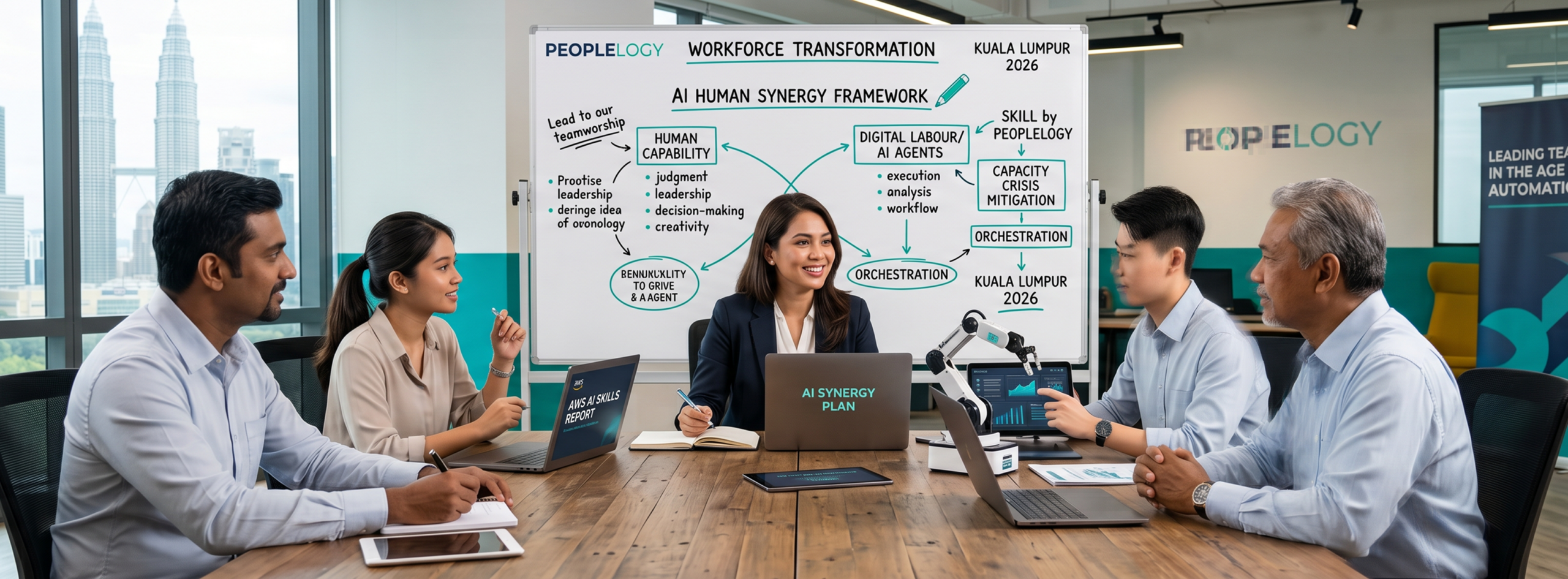
This disconnect reveals critical insight. AI does not automatically create productivity. True transformation happens when organisations develop AI Human Synergy, where intelligent systems handle execution while human professionals focus on strategic thinking, interpretation, and decision making.
From AI Tools to Digital Labour
The role of AI within organisations is also evolving rapidly.
According to Forrester’s 2026 technology predictions, organisations are moving beyond simple automation tools towards role-based AI agents capable of managing end-to-end workflows. In other words, AI is beginning to function as digital labour rather than just a productivity assistant.
This shift is already visible across several sectors.
In financial services, AI driven analytics can identify patterns in fraud detection that previously required hours of manual analysis. In manufacturing, predictive maintenance systems analyse machine behaviour to prevent equipment failure before it occurs. Healthcare providers are also beginning to integrate AI driven diagnostic support to improve clinical decision making.
However, these technologies do not eliminate the role of human professionals. Instead, they elevate it.
Employees must now move from being task executors to AI orchestrators, professionals who understand how to guide, interpret, and govern intelligent systems.
This requires a new blend of technical knowledge, analytical thinking, and leadership capability.
The Emerging AI Capability Gap
While AI adoption is accelerating across Malaysia, workforce readiness is struggling to keep pace.
Recent research from Amazon Web Services (AWS) indicates that Malaysian employers are willing to offer salary premiums of up to 40 percent for AI skilled professionals. These employees are expected to contribute significantly to innovation, productivity, and digital transformation.
However, a capability gap is emerging.
Many organisations have invested in AI platforms and infrastructure, yet only a small percentage of employees feel confident using these technologies strategically. Analysts increasingly describe this as the emergence of a two tier AI economy, where some organisations successfully integrate AI into business strategy while others remain limited to basic automation.
This challenge is not simply a technological issue. It is a workforce capability issue.
Employees require structured training in areas such as AI literacy, data interpretation, cybersecurity awareness, and digital collaboration in order to work effectively alongside intelligent systems.
Building the AI Ready Workforce
Closing this capability gap requires organisations to rethink how they develop talent.
Rather than treating AI adoption as purely an IT initiative, organisations must approach it as a workforce transformation strategy that integrates people, processes, and technology.
This is where capability development becomes critical.
At PEOPLElogy, workforce transformation programmes focus on equipping professionals with the practical competencies required to operate in AI driven environments. Through initiatives such as SKILL by PEOPLElogy, organisations can strengthen technical expertise in emerging technologies while simultaneously developing leadership and productivity capabilities.
The goal is not simply to train employees on tools, but to build professionals who can interpret insights, make informed decisions, and lead teams in digitally complex environments.
This approach ensures that technology investments translate into meaningful business outcomes rather than underutilised platforms.
Conclusion: Leadership in the Age of AI
Artificial Intelligence will continue to reshape the future of work. However, the organisations that succeed will not be those that adopt the most advanced technologies.
They will be the ones that build the strongest connection between human capability and machine intelligence.
AI can process vast amounts of data, detect patterns, and automate repetitive processes. But it cannot replace human judgement, leadership, and creativity.
In the age of automation, leadership is no longer defined by managing tasks. It is defined by orchestrating synergy between people and intelligent systems.
For organisations navigating digital transformation in 2026 and beyond, the mandate is clear: invest not only in technology, but also in the workforce capabilities that allow AI to deliver its full potential.
Because ultimately, AI does not replace human intelligence. It amplifies it.